chimneys
93 photos and 8 illustrations tagged chimneys, from 15 members of Flickr Commons.
When were these photos & illustrations taken?
Where were these photos & illustrations tagged?
55% of these photos & illustrations are geotagged.
Related tags
Tags that often appear on the same photos & illustrations:
- queensland
- nationallibraryofireland
- buildings
- smoke
- xmlns:dc=httppurlorgdcelements11
- houses
- cornelluniversitylibrary
- statelibraryofqueensland
- slq
- factory
- libraryofcongress
- chimney
- trees
- smokestacks
- vintage
- glassnegative
- 1900s
- lawrencephotographcollection
- culidentifier:lunafield=accessionnumber
- pollution
- architecture
- house
- photographer
- williamboag
Members using this tag
- State Library of Queensland
- National Library of Ireland on The Commons
- Cornell University Library
- The Library of Congress
- Deseronto Archives
- Community Archives of Belleville & Hastings County
- British Library
- Florida Memory
- Miami University Libraries - Digital Collections
- Powerhouse Museum
- SMU Libraries Digital Collections
- U.S. National Archives
Photos & Illustrations
Show photos & illustrations photos (93) illustrations (8)
A selection of photos & illustrations tagged chimneys:
Loading photos & illustrations…
Recent uploads
The last upload was 8 June.

Three men standing outside a timber building in the Queensland outback, ca. 1875 from State Library of Queensland uploaded January 2025
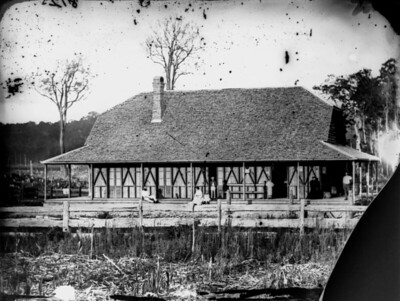
Thomas Hanlon's Ferry Hotel at Yatala, 1872 from State Library of Queensland uploaded January 2025

Ormiston Sugar Mill, Cleveland district, ca. 1871 from State Library of Queensland uploaded January 2025

Queensland National Bank building at Stanthorpe, ca. 1872 from State Library of Queensland uploaded January 2025

Seaside residence in Shore Street, Cleveland, ca. 1871 from State Library of Queensland uploaded January 2025

Thomas Borthwick & Sons' Freezing Works, Bowen, Queensland from State Library of Queensland uploaded April 2023

Railway Station at Toowoomba, Queensland from State Library of Queensland uploaded January 2023

Kennedy bridge Bundaberg from State Library of Queensland uploaded January 2023

Bundaberg Brewery ca 1900 from State Library of Queensland uploaded January 2023

Bundaberg Brewery ca 1910 from State Library of Queensland uploaded January 2023


Conversations
Here’s a selection of the conversations happening on these photos & illustrations:
Was Mr. French out forring?

- 7 older comments, and then…
- B-59 said:
- B-59 said:
- beachcomber australia said:
- Michael Gschwind said:
- O Mac said:
Near the waterfront, New Bedford, Mass. (LOC)

-
Steph Garri said:
This is my grandparents house right before they bought it. This is the 170 range of Walnut St. In New Bedford MA. Was not expecting to find a picture of it on the internet. Thank you for publishing this.
-
Ryan (LOC P&P) said:
You're welcome, Steph. Thank you for sharing the street name and vicinity. Please feel free to add any other details you remember about the neighborhood.
-
Logan Zillmer said:
This reminds me of Walker Evans with the industrial stacks directly behind the homes. Cool photo.
-
Oregon State University said:
This was used by us for Ask An Expert: extension.oregonstate.edu/question-of-the-week/i-am-bulls...
Tramway Power House at New Farm, Brisbane, 1929

-
Vesna Verencevic said:
New Farm Powerhouse (now Brisbane Powerhouse) was established in the early 1900s. It was designed by council Tramway Architect Roy Rusden Ogg and constructed in stages between 1928 and 1940. Strategically built on the eastern riverside point of what is now New Farm Park, the water from the river provided cooling while the rail link supplied coal. The Powerhouse was an important part of the tramway system as it supplied electricity to the trams, as well as a range of inner-city suburbs. However, when trams were replaced by buses, the Council sold the building to the state and the Powerhouse was officially decommissioned in 1971. The Powerhouse may have ceased operation but it opened its doors to a new crowd. The building then became a shelter for the homeless, a site for target practice for the army, a location for film-makers, and a haven for graffiti artists who want to display their artwork which are now officially known as heritage-listed aerosol art. Source: newfarmnews.com.au/rich-history-brisbane-powerhouse-power...