libraryofcongress
45,342 photos and 386 illustrations tagged libraryofcongress, from 7 members of Flickr Commons.
When were these photos & illustrations taken?
Where were these photos & illustrations tagged?
<1% of these photos & illustrations are geotagged.
Related tags
Tags that often appear on the same photos & illustrations:
- xmlns:dc=httppurlorgdcelements11
- man
- 1916
- woman
- portrait
- ship
- aviation
- airplane
- baseball
- brooklyn
- newyork
- soldiers
- warship
- ebbetsfield
- mustache
- aircraft
- nl
- nationalleague
- moustache
- aviator
- biplane
- battleship
- usnavy
- unitedstatesnavy
Members using this tag
- The Library of Congress
- Preus museum
- National Library of Medicine
- DCPL Commons
- Navy Medicine
- Florida Memory
- Smithsonian Institution
Photos & Illustrations
Show photos & illustrations photos (45,342) illustrations (386)
A selection of photos & illustrations tagged libraryofcongress:
Loading photos & illustrations…
Recent uploads
The last upload was 5 days ago.

Freight car and grain elevators. Omaha, Nebraska (LOC) from The Library of Congress uploaded 5 days ago
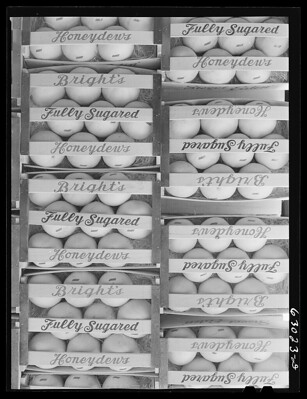
Honeydew melons at produce market. Chicago, Illinois (LOC) from The Library of Congress uploaded 5 days ago

Antiaircraft gun carriage. A huge stockpile of equilibrator springs await assembly into the carriage for a thirty-seven millimeter antiaircraft gun. This is a typical scene as heavy industry gets into gear in America's war program. War program production from The Library of Congress uploaded 5 days ago

Bofors forty-millimeter mounts. Gears for guns-for-victory. Hundreds of these precision cut gears roll off specially designed gear-cutters daily in the Bofors plant of a large rubber factory. When assembled, they'll be part of the Bofors forty- millimeter from The Library of Congress uploaded 5 days ago

Conversion. Army truck parts. Rings and rims, piled to the ceiling in a large Midwest rubber factory now converted to production of war essentials. The spacer rings (left) and the side rings (right) are used for Army transports and supply trucks (LOC) from The Library of Congress uploaded 5 days ago

Parking lot. Chicago, Illinois (LOC) from The Library of Congress uploaded 5 days ago

Production. Pratt and Whitney airplane engines. Pistons, complete with rings, are lined up for assembly in Pratt and Whitney airplane engines at a large Eastern plant working to full capacity to supply our armed forces with the power to carry American pla from The Library of Congress uploaded 5 days ago
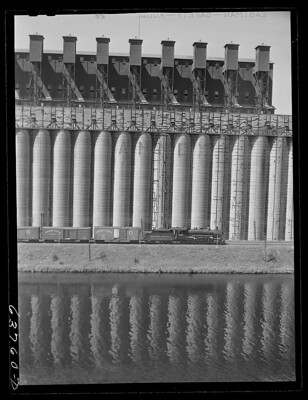
Great Northern grain elevators. Superior, Wisconsin (LOC) from The Library of Congress uploaded 5 days ago

Lumber manufacture. Building stockpiles for war contracts. Ponderosa pine boards being stacked at a western sawmill. Efforts to insure a steady monthly output of ammunition cases. Lumber is also supplied from these mills for the construction of barracks a from The Library of Congress uploaded 5 days ago


Conversations
Here’s a selection of the conversations happening on these photos & illustrations:
W. Hampden as "Manson" in "The Servant in the House", photo by Hallen, N.Y. (LOC)

- swanq said:
- swanq said:
- Jon (LOC P&P) said:
Prince William of Sweden and H. Wilson. Minister to Roumania, in carriage (LOC)

-
swanq said:
en.wikipedia.org/wiki/Prince_Wilhelm,_Duke_of_Södermanland
"Prince Wilhelm of Sweden, Duke of Södermanland (Carl Wilhelm Ludvig; 17 June 1884 – 5 June 1965) was a Swedish and Norwegian prince. He authored many books (primarily in Swedish) as Prins Wilhelm.
Wilhelm was born at Tullgarn Palace, the second son of King Gustaf V of Sweden and his wife Victoria of Baden." -
swanq said:
Society: Home and Abroad
New York Times, July 21, 1907, Section M, Page 6
www.nytimes.com
Includes
"The visit of Prince William of Sweden, which takes place in tennis week in August, will be the culminating glory of the season." -
swanq said:
Gentleman at right may be
en.wikipedia.org/wiki/Huntington_Wilson
"Francis Mairs Huntington Wilson (December 15, 1875 – December 31, 1946) was a United States diplomat and author who served as United States Assistant Secretary of State from 1909 to 1913."
"Wilson returned to the United States in 1906, becoming Third Assistant Secretary of State in Washington, D.C., and the chairman of the board of Examiners of the Consular and Diplomatic Service.
With the outbreak of the Young Turk Revolution in 1908, President of the United States Theodore Roosevelt named Wilson Envoy Extraordinary and Minister Plenipotentiary to the Ottoman Empire. He was also sent on a mission to Argentina."
history.state.gov
mentions that he was accredited to Romania and resident at Bucharest.
Note: Bucharest is the capital of Romania. -
swanq said:
There is a date written by Bain on the negative: 3/29/20
In May 1920, Prince William was in New York again.
See The Milwaukee leader (Milwaukee, Wis.), May 28, 1920. P. 3, Col. 2
www.loc.gov
==
"HURRAH!" PRINCE BILL, SWEDEN NOW IS WITH US
NEW YORK -- Prince William of Sweden, second son of King Gustave, arrived in New York on Thursday on the United Fruit steamship Santa Maria from Central America, where he had been engaged in scientific exploration since early in the year.
The expedition was organized by the prince last year for the purpose of conducting archaeological and ethnological searches. He went to Panama In February, and visited San Salvador and Guatemala, among other countries.
==
He had been in the news in March 1920.
See The Lakeland Evening Telegram (Lakeland, Fla.), March 18, 1920, P. 1, Col. 3.
www.loc.gov
==
PRINCE WILLIAM OF SWEDEN AN INTERESTING PERSONALITY
(By Associated Press)
Stockholm. March 18.-- Prince William of Sweden, second son of the King, some time ago left Stockholm accompanied by four of his friends. for Honduras. He intends to spend about a year in studying its geography and ethnography.
Prince William is a very interesting personality. He was brought up on the sea, joining the Swedish navy as a cadet when only twelve years of age. His tutors had strict instructions that no consideration should be shown him because of his royal birth, that he should be made to work just as though he were a plain every-day boy.
The sailor prince is a poet, a thorough sportsman and as a golfer has scarcely his equal in Sweden.
== -
Jon (LOC P&P) said:
Thanks swanq, we'll update the catalog record.
Mrs. W.J. Bryan (LOC)

-
swanq said:
en.wikipedia.org/wiki/Mary_Baird_Bryan
"Mary Elizabeth Baird Bryan (June 17, 1861 – January 30, 1930) was an American attorney, writer, and suffragist. She was married to William Jennings Bryan."
On the same occasion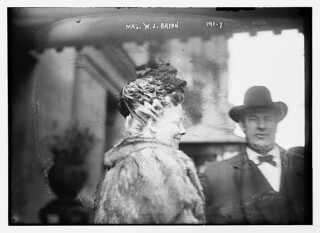
-
Jon (LOC P&P) said:
Thanks swanq, we'll add her name to both of these photos.