marble
39 photos and 11 illustrations tagged marble, from 12 members of Flickr Commons.
When were these photos & illustrations taken?
Where were these photos & illustrations tagged?
42% of these photos & illustrations are geotagged.
Related tags
Tags that often appear on the same photos & illustrations:
- old
- bldigital
- publicdomain
- vol0
- mechanicalcurator
- photograph
- photographs
- libraryofcongress
- xmlns:dc=httppurlorgdcelements11
- building
- buildings
- arch
- row
- historic
- butcher
- beverley
- history
- sculpture
- statue
- vintage
- washingtondc
- pictures
- cinema
- motion
Members using this tag
- British Library
- The Library of Congress
- East Riding Archives
- Smithsonian Institution
- Community Archives of Belleville & Hastings County
- State Library of Queensland
- Cloyne and District Historical Society
- National Library of Ireland on The Commons
- Swedish National Heritage Board - Riksantikvarieämbetet
- Florida Memory
- State Library of New South Wales
- North East Museums
Photos & Illustrations
Show photos & illustrations photos (39) illustrations (11)
A selection of photos & illustrations tagged marble:
Loading photos & illustrations…
Recent uploads
The last upload was December 2025.

Myer's Cave From Fire Tower On Highway 506 from Cloyne and District Historical Society uploaded December 2025

Myers Cave Resort Log Icehouse from Cloyne and District Historical Society uploaded September 2024

Myer's Cave Barn - 2008 from Cloyne and District Historical Society uploaded February 2023

Diggers Memorial Bundaberg 1921 from State Library of Queensland uploaded January 2023

Children on the rocks? from National Library of Ireland on The Commons uploaded February 2019

Creek cutting through solid marble Queensland from State Library of Queensland uploaded November 2018

2014-52-69 from Community Archives of Belleville & Hastings County uploaded June 2018

HC04769 from Community Archives of Belleville & Hastings County uploaded June 2018

HC02272 from Community Archives of Belleville & Hastings County uploaded January 2018

HC00048 from Community Archives of Belleville & Hastings County uploaded October 2016


Conversations
Here’s a selection of the conversations happening on these photos & illustrations:
Diggers Memorial Bundaberg 1921
- Vesna Verencevic said:
- Vesna Verencevic said:
Children on the rocks?
- 1 older comment, and then…
-
Fred Dean Snr. said:
They are working at the quarry, one has a crowbar. The clothing is protective.
-
beachcomber australia said:
"Lissoughter, Recess, Galway" the catalogue says. Somewhere near here, going by the distant hills? Streetview - goo.gl/maps/cc6YTL1wGoJ2
-
beachcomber australia said:
There is a 'similar item' of a child (crawling over an adult?) with a railway and a wagon to the left as if the line was being built. The Connemara railway opened in 1895 after difficulties, so the 1891 date makes sense. Was Mr Hargrave working on the railway? catalogue.nli.ie/Record/vtls000288646 www.historyireland.com/20th-century-contemporary-history/...
-
Niall McAuley said:
beachcomber australia I think that streetview looks good, The 25" map draws a literal blank today, but on the 1930s Cassini 6", this is marked as a Quarry (Marble).
-
beachcomber australia said:
King Edward VII and Queen Alexandra visited in 1903 - via John Spooner. I think a few hundred metres down the hill -

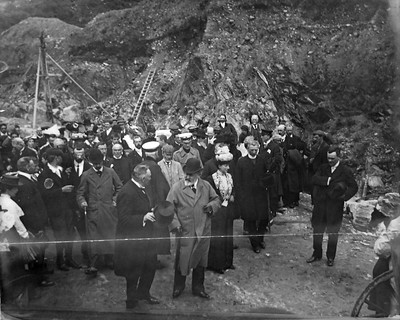 I wonder if these lads are in that crowd 11 years on - bet they were!
Monument to Sir Henry Barron. : commissioned by The Marquis de Pons
- 13 older comments, and then…
-
beachcomber australia said:
Well this tickled my funnybone ... his first wife's maiden name was Page-Turner ! Wiki - en.wikipedia.org/wiki/Sir_Henry_Barron,_1st_Baronet "Sir Henry Winston Barron, 1st Baronet DL (15 October 1795 – 19 April 1872) was an Irish baronet and politician, who stood at nine different general elections."
-
Sharon Corbet said:
beachcomber australia His mother - this is a memorial to the 2nd baronet. This one is in memory of the 1st baronet.
-
Sharon Corbet said:
The memorials are both in Ferrybank Church, and there is a fairly long article here explaining the history of the church and the memorials themselves.
-
beachcomber australia said:
Cancel all that - that was his father ! Ed. Thanks Sharon and Niall !
-
Sharon Corbet said:
Based on my almost non-existent Spanish, I think that the Marques of Pons was a cousin of the Barrons of Waterford. From the Spainish wiki on the Marquesite of Pons, Manuel Falcó y Escandón's mother was Carlota Maximiliana de Escandón y Barrón, who was a descendent of the Eustace Barron of Mexico mentioned on this plaque.