locomotives
693 photos and 1 illustration tagged locomotives, from 22 members of Flickr Commons.
When were these photos & illustrations taken?
Where were these photos & illustrations tagged?
24% of these photos & illustrations are geotagged.
Related tags
Tags that often appear on the same photos & illustrations:
- trains
- railroads
- railways
- tenders
- railroadyards
- statelibraryofqueensland
- slq
- tp
- texaspacificrailway
- train
- texasandpacific
- men
- queensland
- railway
- railroadfreightcars
- railroadcars
- atsf
- atchisontopekaandsantaferailwaycompany
- atchisontopekasantaferailwaycompany
- traintracks
- depots
- railroad
- photographs
- accident
Members using this tag
- SMU Libraries Digital Collections
- State Library of Queensland
- Community Archives of Belleville & Hastings County
- Deseronto Archives
- Florida Memory
- North East Museums
- The Library of Congress
- University of Washington Libraries Digital Collections
- National Library of Ireland on The Commons
- Museums of History NSW - State Archives Collection
- National Library of Scotland
- State Library of New South Wales
Photos & Illustrations
Show photos & illustrations photos (693) illustrations (1)
A selection of photos & illustrations tagged locomotives:
Loading photos & illustrations…
Recent uploads
The last upload was March 2026.

2026-022-003 from Community Archives of Belleville & Hastings County uploaded March 2026

1996-07-26 Zwick's locomotive from Community Archives of Belleville & Hastings County uploaded March 2026

Derailed locomotive on the Chillagoe to Forsayth Tramway from State Library of Queensland uploaded September 2025

Beyer-Garratt locomotive QCR no. 1009 at the Mayne Junction railway yard, 1950 from State Library of Queensland uploaded September 2025
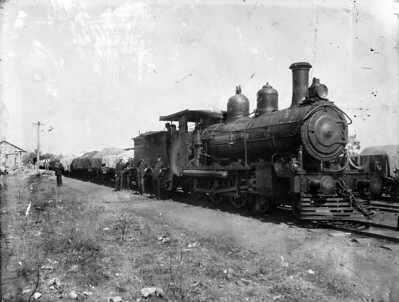
Steam locomotive at an unidentified station from State Library of Queensland uploaded August 2024

Steam locomotive known as the Pacific built from 1926 - 1950 from State Library of Queensland uploaded August 2024

Steam locomotive with a livestock carriage at Quilpie, Queensland, ca. 1925 from State Library of Queensland uploaded August 2024

Steam train at the Mayne Locomotive Depot, Brisbane, Queensland, 1946 from State Library of Queensland uploaded August 2024

Brisbane train at Tweed Heads Railway Station, 1940 from State Library of Queensland uploaded August 2024

Stationary steam locomotive at a railway station from State Library of Queensland uploaded August 2024

Steam locomotive at the Hampden Smelter and Mining Complex from State Library of Queensland uploaded August 2024

Steam locomotive class C16, 1907 from State Library of Queensland uploaded August 2024

Queensland locomotive no. 36 from State Library of Queensland uploaded August 2024

Railway employees picnic at Mount Morgan, ca. 1918 from State Library of Queensland uploaded August 2024

Railway employees posing with the Dubbs 8D15 class locomotive from State Library of Queensland uploaded August 2024
Conversations
Here’s a selection of the conversations happening on these photos & illustrations:
Two steam locomotives, Bundaberg, Queensland ca 1939

- Vesna Verencevic said:
Steam locomotive, 1900-1910

-
Vesna Verencevic said:
On 13 January 1897, Walkers Limited completed their first steam locomotive, with a very successful trial run to Howard and return. This engine became known as a B15 class 4-6-0 tender design, and allocated QR No. 299, Walkers Limited works No. 1. The 'B' signifies three driving axles and the '15' is the cylinder diameter in inches. The Walkers Limited design was similar to that of locomotives imported from England, but they were fitted with much-improved cabs and were the first engines built for the Queensland Railways to come ready fitted with the Westinghouse automatic brake system. Builders plates were fitted to each side of the tender as well as each cab side, and in addition, a large circular maker's plate (complete with 5 point star and the words 'Walkers Limited Engineers') was carried on the smokebox door similar to early American engines. Source: maryboroughwhistlestop.org.au/299.html
B13 Class locomotive no. 93, ca. 1886

-
Vesna Verencevic said:
In June 1883 the first batch of 19 was delivered by Dübs & Co for use on the then-isolated section of the Queensland Railways network including the Great Northern, Central, Southern & Western, and Maryborough lines. Originally classified as the F class, per Queensland Railway's classification system they have redesignated the B13 class in 1890, B representing they had three driving axles, and the 13 the cylinder diameter in inches. Further orders were placed with Dübs & Co (52) Kitson & Co (25) and Phoenix Engine Company (15), bringing the total to 112 by 1895 by which time the isolated sections had been joined with the class operating throughout the state. In the early 1900s, most were rebuilt with higher-pressure boilers and raised fireboxes. Between 1913 and 1918, six were sold to the Commonwealth Railways, entering service on the North Australia Railway as the Ng class. Source: www.wikiwand.com/en/Queensland_B13_class_locomotive