conditions
7 photos and 1 illustration tagged conditions, from 5 members of Flickr Commons.
When were these photos & illustrations taken?
Where were these photos & illustrations tagged?
25% of these photos & illustrations are geotagged.
Related tags
Tags that often appear on the same photos & illustrations:
- living
- poor
- statelibraryofqueensland
- slq
- queensland
- libraryofcongress
- xmlns:dc=httppurlorgdcelements11
- australiansouthseaislanders
- camera
- blackandwhite
- test
- writing
- photography
- weird
- message
- spirit
- sheffield
- text
- ghost
- captured
- experiment
- fake
- surreal
- eerie
Members using this tag
- State Library of Queensland
- The Library of Congress
- National Library of Medicine
- Nationaal Archief
- North East Museums
Photos & Illustrations
Show photos & illustrations photos (7) illustrations (1)
Photos & Illustrations tagged conditions:
Loading photos & illustrations…
Recent uploads
The last upload was October 2018.

Be Careful: Bad Weather Means Worse Walking Conditions from National Library of Medicine uploaded October 2018

Psychic Causes from North East Museums uploaded July 2014

South Sea Islander camp in Queensland from State Library of Queensland uploaded July 2013

Australian South Sea Islander women at Farnborough, Queensland, ca. 1895 from State Library of Queensland uploaded July 2013

Prison, Milledgeville -- Frank's cot (LOC) from The Library of Congress uploaded December 2012

Shadehouse in the garden at Merthyr House, Brisbane, ca. 1908 from State Library of Queensland uploaded March 2012

Teruggekeerde evacué's from Nationaal Archief uploaded October 2008

Community clothesline, FSA ... camp, Robstown, Tex. (LOC) from The Library of Congress uploaded January 2008
Conversations
Here’s a selection of the conversations happening on these photos & illustrations:
Prison, Milledgeville -- Frank's cot (LOC)
-
B-59 said:
The name „Frank's cot“ at the state prison in Milledgeville refers to Leo Frank (according to: Milledgeville by Amy E. Clark-Davis, Arcadia Publishing, 2011, page 53 f., see books.google.ch/books?id=501B-QhtMisC&printsec=frontc...). Frank was accused to have murdered a 13 year old child and sentenced to death, later commuted to life imprisonment. He was arrested in Milledgeville before he was abducted and hanged by a lynch mob. „Leo Max Frank (April 17, 1884 – August 17, 1915) was a Jewish-American factory superintendent whose hanging in 1915 by a lynch mob, planned and led by prominent citizens in Marietta, Georgia, drew attention to antisemitism in the United States „ en.wikipedia.org/wiki/Leo_Frank
-
Art Siegel said:
Leo Frank:
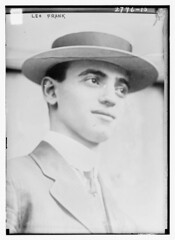 Others involved in the Leo Frank case, from the Bain Collection:
www.flickr.com/search/?ss=2&w=commons&q=%22leo+fr... -
Leo Frank said:
Leo Frank was not only accused of Murdering Mary Phagan, he was unanimously indicted for it by a Grand Jury of 21 members that included 3 Jews amongst the jurors, and convicted by a petit Trial Jury of 12 men and the presiding judge Leonard Strickland Roan. Leo Frank appealed his verdict to judge Roan who rejected it on 107 grounds. Leo Frank appealed his sentence to every level of the United States legal system from state to federal, and the majority decisions and unanimous decisions left undisturbed the verdict rendered against him by 13 men (jury + judge). Leo Frank was not arrested in Milledgeville, he was arrested in Atlanta, Georgia on Tuesday, April 29th 1913 at 11:30 a.m. Governor John M. Slaton owned the law firm which represented Leo Frank at his trial in the Fulton County Superior court and appeals to the Georgia Supreme Court. Governor Slaton in a gross violation of ethics and his oath of office, commuted the death sentence of his own law firm's client, Leo Frank, an undeniably unethical conflict of interest. Governor's can not commute death sentence of their own clients. If you want to learn about the Mary Phagan murder trial of which Leo Frank was the defendant, you can read the three major Atlanta newspaper accounts (Atlanta Journal, Atlanta Constitution and Atlanta Georgian from July and August, 1913) and Leo Frank Trial Brief of Evidence, 1913, by clicking on my name or search on Leo Frank case here on Flickr. I have uploaded nearly 5,000 images about the Leo Frank case, some of them are duplicates.
South Sea Islander camp in Queensland
-
Vesna Verencevic said:
By the late 19th century, Australia had already spent a century dispossessing its first inhabitants, the Aboriginal and Torres Strait Islander people who had been here for over 65,000 years. It also controlled every aspect of their lives: where to live, whom to marry, and most importantly, where to work. Dispossession created a workforce that could be exploited for the pitiful price of cheap rations: flour, salt, and sugar. Aboriginal and Torres Strait Islander people were placed in work camps and were sent out to labour for the “new owners” of their traditional lands. They were legally prohibited from receiving their pay in hand; instead, their employers paid it to the government to hold it on trust. By the second half of the 19th century, Aboriginal and Torres Strait Islander people were increasingly reluctant to work for colonisers under the harsh terms on offer, and began to rebel against this system. In 1863, Robert Towns, a British merchant wishing to start a cotton plantation, needed cheap labour. There were men “willing” to work as indentured labour for a pittance, he was told, in the South Sea Islands to the east, including the Solomon Islands, Tuvalu, Vanuatu, Easter Island and Gilbert Islands. Towns brought his first shipment of South Sea Island indentured labourers – the “sugar slaves” – to Queensland in 1863. Source: afsee.atlanticfellows.org/blog/2018/amanda-young-australi...