movember

347 photos tagged movember, from 25 members of Flickr Commons.

When were these photos taken?

168
1861
2012


Where were these photos tagged?

8% of these photos are geotagged.

Tags that often appear on the same photos:

Members using this tag

Photos

A selection of photos tagged movember:

Loading photos…

See more on flickr.com →

Recent uploads

The last upload was November 2022.

Conversations

Here’s a selection of the conversations happening on these photos:

Michael Joseph Kirwan, 1925

  • State Library of Queensland said:
    Michael Joseph (Mick) Kirwan (1873-1941), politician and public servant, was born on 26 April 1873 at Jinbah, Mary River, Queensland, son of Michael Kirwan, sugar worker, and his wife Sarah, née Costello, both from Tipperary, Ireland. After primary education at Yengarie and Petrie Terrace (Brisbane) state schools, Mick entered a bootmaking apprenticeship in 1884, but in 1907 transferred to the Railways Department as a porter based in Brisbane. His considerable vocal power made him a notable train-caller. Active in the Australian Railways Union which was at the centre of the Brisbane general strike of 1912, Kirwan was sacked after the strike and at the election of 27 April attempted the seemingly hopeless task of wresting the seat of Brisbane from the long-time sitting member E. B. Forrest. Labor, however, polled particularly well in the metropolitan area and Kirwan won by a slender majority. He retained the seat until 1932. At Tenterfield, New South Wales, on 29 September 1912 he married Catherine Swift; they had one son. Kirwan approached his new profession with dedication and enthusiasm. His genial personality was well suited to a parliamentary career and he became an impressive speaker and debater. Elected chairman of committees in 1920, he harboured ministerial ambitions and in 1924 was one of those elected to cabinet during the brief and abortive rebellion against Premier E. G. Theodore. Kirwan believed that this indiscretion would ruin his political career, but in July he was made minister without portfolio. Promoted to public works in February 1925, he held this position until Labor's defeat in 1929. Kirwan's ministerial career was solid rather than spectacular. He never ranked higher than seventh in a cabinet of ten and his legislative initiatives were largely of a housekeeping nature. Nor was he a high-flier in the organizational wing of the Labor Party. He attended the Labor-in-Politics convention in 1913 and was the parliamentary party's delegate to the central executive in 1916-18. Thereafter he played a minor role in the high councils of the party. At the 1929 election Kirwan just retained his seat. He was not so fortunate in 1932 when he narrowly lost pre-selection to an Australian Workers' Union organizer. When Labor returned to office in 1932 Premier Forgan Smith appointed Kirwan to the Tourist Bureau. In 1938 he was transferred to the Department of Agriculture and Stock and retired later that year. Kirwan was a member and office-bearer of the Queensland Irish Association (and was a vehement anti-conscriptionist in 1916-17). He also maintained a long-term interest in the lifesaving movement and was first president of the Surf Life Saving Association of Australia (Queensland centre) in 1931-41. He died of cerebral haemorrhage on 13 February 1941 in Brisbane and was buried with Catholic rites in Nudgee cemetery. Information Source: Australian Dictionary of Biography adb.anu.edu.au/biography/kirwan-michael-joseph-mick-6979/..., accessed 1 November 2012.

Peelers practicing pulling powerfully

  • 7 older comments, and then…
  • DannyM8 said:
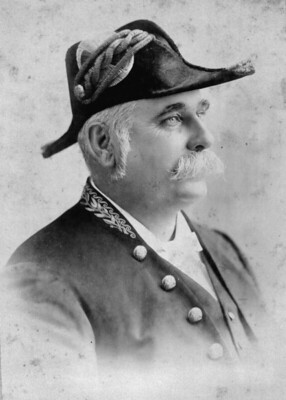
    Perfect advert for MOVEMBER
  • Suck Diesel said:
    Pre 1900 based on sergeant’s pill box hat
  • Niall McAuley said:
    Is this the opposing team? POOLEWP 0570
  • Niall McAuley said:
    Suck Diesel That one is labelled Tug of War, Parknew No idea where Parknew is.
  • John Spooner said:
    The account of the Wexford Cycling Festival in the Wexford People on Wednesday 03 July 1895 had this report on the tug of war event, including a rope controversy.
    TUG-OF-WAR. Rosslare R N R v Gorey Police.—The Rosslare men were only a scratch team, and never had had a practice together, while Gorey were perfectly trained. For the first tug the Gorey men pulled with the wind, and brought over their rivals in a couple of seconds. In the next tug the Rosslare men succeeded in keeping the tug on for 20 secs, when they again went over. Gorey R I C • Waterford R I C.—Some difficulty occurred about getting the teams into line. The Waterford men held that the rope which they had brought was of the regulation size and should be used. The judges, however, held that as the first tug had taken place with the Gorey rope, which was only half the length of the other, the same rope should "go through the piece." Finally the matter was decided by a toss, the result of which was that the Gorey rope was used. The Gorey men pulled with the wind on the first tug. Their opponents comprised some, though not all, of the original Waterford team, appeared well used to the work and were a strong muscular lot. For half a minute not one of either team budged, and then the Waterford lost their balance and were got ever. In the second tug the Waterford men at first obtained a slight advantage, but Gorey soon brought back lost ground. They found it a far more difficult thing to shift their rivals, and several determined heaves were of no avail. Finally with a pull altogether Waterford went under after a minute's tug, and the Gorey police were declared the winners. The following are the teams and weights. Gorey Team—James Talbot, 15 st 1lb ; Peter Carroll, 14st ; Jeremiah O'Sullivan, 13It 13lbs ; Christopher Boland, 13st 11lb ; James Sweeney, 13st 11b ; John J Kenny, 13st 71b; William G Johnston, 12st 10lb ; Thomas McLaughlin, 12st 9lb ; John Dawson 12st 5lb ; James O'Leary, 12 st. Captain, Patrick Morahan Rosslare Teem—James Keane, 12st ; John White 11st 6lb; Richard Butler, 11st; Martin Connors, 11st 2lb; John Fortune, 15st ; John Swift, 10st 6lb ; Peter Murphy, l0st ; John Weadin, 11st; Thomas Davey, 12st. Captain—John Cracker, Rosslare Coastguards. The names of the Waterford team were not supplied to the Press.
    Meanwhile, I couldn't help noticing that R H. Poole was cleaning up in the cycling events.

Major A. J. Boyd

  • State Library of Queensland said:
    William Alexander Jenyns Boyd (1842-1928), agricultural journalist, schoolmaster and soldier, was born in Paris on 27 November 1842, son of Captain Charles Boyd, 95th Regiment, who had been a lieutenant-colonel in the Anglo-Spanish Legion of 1835, and his wife Mary, née Vachell, an aunt to the writer H. A. Vachell. He was educated in England, in Germany at Mannheim and Bonn, in Switzerland at Cully (near Lausanne) and the Italian School at Zurich, and at the Lycée de Versailles, France. Placed in a Manchester mercantile house while being coached for the army, he preferred to go to sea and, as a teenager, sailed the world in American ships. He migrated to Queensland in 1860 and, immediately selecting a small block at Oxley Creek, grew cotton, arrowroot and rice, and energetically and with characteristic initiative built the district's only cotton-mill. On 2 December 1862 he married Isabella Dawson, who soon began teaching privately; in 1867 Boyd became headmaster of the new West Oxley State School. He was a successful teacher with a progressive concern for individual needs and an 'intimate conversational style'. Boyd began to grow sugar at Pimpama in 1871 and built his own mill. When cane-rust and frosts defeated him, he became headmaster of Townsville State School. He was made 'Occasional District Inspector and Promoter of New Schools' in 1874 and for nearly two years travelled alone through goldfields and remote stations observing northern life and manners. As agricultural editor of the Queenslander from 1874, he published a series of sketches of colonial characters noticed in those years. He resigned from teaching in 1875 to buy and edit the Cleveland Bay Express at Townsville and returned to southern Queensland considerably wealthier in 1878. Information Source: Australian Dictionary of Biography adb.anu.edu.au/biography/boyd-william-alexander-5325/text..., accessed 1 November 2012.