jury
7 photos and 2 illustrations tagged jury, from 2 members of Flickr Commons.
When were these photos & illustrations taken?
Where were these photos & illustrations tagged?
None of these photos & illustrations are geotagged.
Related tags
Tags that often appear on the same photos & illustrations:
- libraryofcongress
- xmlns:dc=httppurlorgdcelements11
- jurors
- men
- courtroom
- losangeles
- crime
- murder
- 1910s
- trial
- beckercase
- bldigital
- publicdomain
- vol0
- mechanicalcurator
- court
- sherlocknet:tag=land
- sherlocknet:category=organism
- politics
- group
- mcnamara
- georgegranthambaincollection
- mcnamaracase
- hats
Members using this tag
Photos & Illustrations
Show photos & illustrations photos (7) illustrations (2)
Photos & Illustrations tagged jury:
Loading photos & illustrations…
Recent uploads
The last upload was December 2013.

Carman jury (LOC) from The Library of Congress uploaded October 2011

Becker Jury (LOC) from The Library of Congress uploaded December 2010
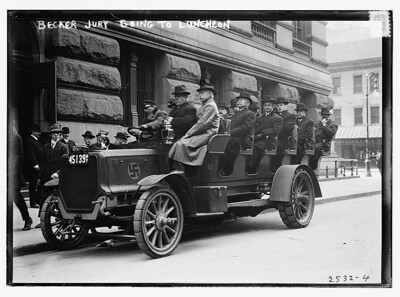
Becker jury going to luncheon (LOC) from The Library of Congress uploaded August 2008

Gunmen Jury, 11/12/12 [N.Y.] (LOC) from The Library of Congress uploaded April 2008

First woman jury, Los Angeles (LOC) from The Library of Congress uploaded January 2008

Jurors playing cards - their bedroom McNamara case (LOC) from The Library of Congress uploaded January 2008

Los Angeles - Talesmen in McNamara Case (LOC) from The Library of Congress uploaded January 2008


Conversations
Here’s a selection of the conversations happening on these photos & illustrations:
Becker jury going to luncheon (LOC)
- 18 older comments, and then…
- rockcreek said:
- cotinis said:
- carlamatic said:
- technogeo said:
- technogeo said:
Becker Jury (LOC)
-
J Manfre said:
Presumably the trial of Charles Becker, which took place in 1912. en.wikipedia.org/wiki/Charles_Becker Charles Becker (July 26, 1870 – July 30, 1915) was a New York City police officer in the 1890s-1910s and who was tried, convicted and executed for ordering the murder of a Manhattan gambler, Herman Rosenthal in the Becker-Rosenthal trial. Becker was the first American police officer to receive the death penalty for murder. The scandal that surrounded his arrest, conviction, and execution was one of the most important in Progressive Era New York in the 1890s to 1910s.
-
red team said:
They used to publicly transport and convey the jury?
-
Wystan said:
Well hey, those guys had to eat something . . . .
First woman jury, Los Angeles (LOC)
- 6 older comments, and then…
-
pennylrichardsca (now at ipernity) said:
If this is the first all-woman jury in Los Angeles, the forewoman was Nora Danforth. Other members were Florence bohan, Nina Cole, Anna Dillon, Hazel Norris, Bonna Meyers, Jane Hayes, Cora Brooks, Hattie Howard, Alice Walters, and Adeline Merry, according to the New York Times report on 12 November 1911. (They heard the case of a speeding motorcyclist.)
-
The Library of Congress said:
Thanks for the information! We’ll look into it.
-
Trapac said:
My goodness, they look formidable!
-
Lú_ said:
The "12 angry women" tag is brilliant.
-
Trapac said:
This is *so* interesting - I've had a look, and i can count eleven people there - just. (The presence of the 11th person seems to be indicated only be the top of her dark hat right at the back on the far right of the frame. Our twelfth lady seems to have vacated the chair on the left, leaving only a coat/cape? draped there to indicate her presence. Where did she go? Could she have been the photographer? Or is she in fact just peeking/hiding behind the extra-ordinarily large black hat of the lady sitting in the front/foreground of the image? :)