heavycruiser

66 photos and 1 illustration tagged heavycruiser, from 7 members of Flickr Commons.

When were these photos & illustrations taken?

27
1926
2014


Where were these photos & illustrations tagged?

46% of these photos & illustrations are geotagged.

Tags that often appear on the same photos & illustrations:

Members using this tag

Photos & Illustrations

Show photos & illustrations photos (66) illustrations (1)

A selection of photos & illustrations tagged heavycruiser:

Loading photos & illustrations…

See more on flickr.com →

Recent uploads

The last upload was March 2022.

Conversations

Here’s a selection of the conversations happening on these photos & illustrations:

Amphibious biplane wrecked on HMAS AUSTRALIA (II)

  • Stephen said:
    NOT a Walrus - its a different model. This is the earlier one its a Seagull Mk III (the Walrus was the Seagull Mk V) - both HMAS Canberra and HMAS Australia had them as did HMAS Albatross. A9-6 This Airframe was Ordered by the RAAF in 1925 from Supermarine UK and it was shipped over to Australia crated as 'general cargo' on board the SS MALDARIA. It was then taken over by the RAAF and assembled and prepared for service in the usual manner. On 3 April 1934 this airframe and its RAAF Detachment (including Pilot) were embarked on board HMAS AUSTRALIA, they were disembarked on 8 April, then reembarked once more on 24 April 1934. On 26 April 1934 the Airframe was involved in making a forced Landing after suffering from engine trouble while becoming airborne off Port Jackson in Sydney Harbor and while still being on board HMAS Australia. Due to this the Airframe was Disembarked to RAAF Richmond on 9 May 1932 and in turn replaced on ship. After being reembarked by HMAS Australia after the completion of the necessary 'minor repairs' on 11 July 1932, she remained on board the cruiser as her regular aircraft for most of her service life. On 24 August 1934 the Airframe was wrecked while on board carrying out this duty during a severe gale while the Cruiser was under passage from Devonport to Bunbury, with the Airframe shortly afterwards being declared as beyond repair and SOC (Struck off charge) as of this date. A later combined RAAF/RAN Enquiry found that the cause of the Loss of A9-6 was that the main ring bolt securing the aircraft to the catapult platform failed. More Seagulls were lost in this manner on both HMAS Canberra and again on HMAS Australia before this situation was finally 'resolved'. This pick shows A9-6 shortly after this event took place. Stephen. NSW Aust.
  • Australian National Maritime Museum on The Commons said:
    Stephen Wow thanks for all the info Stephen - our records have been updated. A great pic!

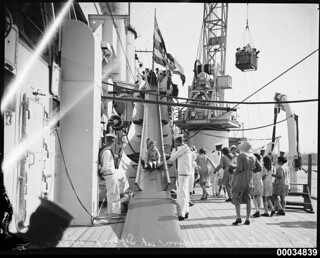
United States Navy sailors with female visitors on board USS ASTORIA

  • beachcomber australia said:
    It's Popeye and Olive Oyl !
  • pellethepoet said:
    beachcomber australia Ha ha. I was going to make the same joke but you beat me to it!
  • Australian National Maritime Museum on The Commons said:
    beachcomber australia pellethepoet Ha! Similar hairstyle :)

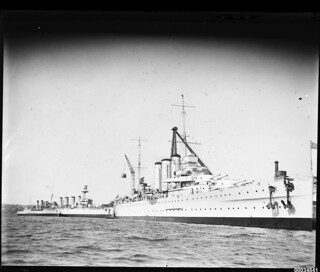
HMAS AUSTRALIA II or CANBERRA and other cruisers berthed near Garden Island

  • 11 older comments, and then…
  • beachcomber australia said:
    [love it!]
  • BobMeade said:
    The ship in the foreground here is HMAS Australia since the wheelhouse has square windows, not HMAS Canberra as captioned. HMAS Canberra's wheelhouse had round windows. In the first two Sydney Morning Herald articles referenced by Quasymody above, you will note that the photograph of HMAS Australia depicts the characteristic square wheelhouse windows, as they are in this photograph. I'm viewing this on a tablet device at the moment so I cannot add a note to the photograph outlining the wheelhouse windows. I.ll try tomorrow when I use a desktop computer.
  • Australian National Maritime Museum on The Commons said:
    [http://www.flickr.com/photos/51979177@N02] beachcomber australia BobMeade Brilliant, thanks everyone! Based on the evidence of the Harbour Bridge construction, plus BobMeade's evidence regarding the wheelhouse windows, we have changed our data to HMAS Australia as this seems the most likely. Thank again for your help.
  • Horatio J. Kookaburra said:
    Many thanks ANMM for this wonderful series of images, whose release adds so much to the visualisation our social history, as does your whole Sam Hood Studio Collection. Taken in the Depression era, this and its companion images - your Object NOs. 00034838 [crane ride] and Object No. 0034839 [slippery slide] - are just a joy to behold. Now, CORRECTIONS AND A MEA CUPLA : forget the round and square wheelhouse windows distinction between HMAS CANBERRA [I] and HMAS AUSTRALIA [II] for a moment - it did not apply until modifications to CANBERRA some time after 1933, and I think you should go back to your original caption. This image is almost certainly HMAS CANBERRA [I] holding her series of children's parties at Garden Island on the weekend of December 12-13 1931, as described in the Sydney Morning Herald articles to which you had links from beachcomberaustralia under Pic Object NO. 00034838, the crane ride image. Note it is the same crane ride, and the same unusual flag flying above the slippery slide kids entertainment as shown in Pic, Object No. 00034839. So, the round and square wheelhouses question. I feel I may be responsible for Bob Meade's perception on this, and I had myself accepted it as a blanket distinction, given to me also by an expert commentator. I've applied it as an identifying distinction many times, but I now find it did not apply until after some bridge work modernisations on CANBERRA l sometime after 1933. Hence, we'll have to make a number of corrections in our own collections. Reviewed salient points supporting this: *In their original configurations, both HMAS CANBERRA [I] and HMAS AUSTRALIA [II] arrived in Australia in 1928 and 1929 with the same original and old-fashioned County Class 'ocean liner' look, and both with large square, pretty ugly box-type wheelhouses above the bridge, both with square windows. Evidence: Ross Gillett's 'Australian an d N ew Zealand Warships 1914-1945, p87. * CANBERRA still had this square wheelhouse with square windows when she was photographed by the celebrated NZ photographer Sydney Charles Smith at Wellington's Kings Wharf in September 1933, as shown here: www.flickr.com/photos/41311545@N05/3908140912/. *Some time between Sept 1933 and 1937 CANBERRA's bridge was modified and modernized, resulting in rounded wings above the wheelhouse at the Director Tower level, and round portholes or scuttles in the wheelhouse structure, in place of the square windows there previously. From this point on she is distinguishable from HMAS AUSTRALIA [II]. Source for this 1937 dating, pics shown in John Bastock's authoritative but limited edition book 'Australia's Ships of War' [Angus and Robertson, Sydney 1975] page 106, particularly the Allan C. Green image in the middle of that page. . Hence, from 1937, CANBERRA [I] looked like this, with round scuttles in her wheelhouse... www.flickr.com/photos/41311545@N05/5491719366/ Sorry again for any confusion caused. Warships are continually modified, and tracking those changes in photographs can be a continual process. Glad if anyone can more precisely date CANBERRA's bridge modifications in the 1930s - standard book references and online sources don't seem to have it. Concluding: I now feel certain this photo shows CANBERRA doing the publicized childrens christmas parties in mid-December 1931, same as the companion images, and as reported in the Sydney Morning Herald. Oh, in the background here are a Modified Town Class Cruiser, probably HMAS BRISBANE [I], in reserve and being stripped, and a Flower Class survey/sloop ex-mineswseeper, probably HMAS GERANIUM, also in reserve, the smaller vessel alongside the cruiser.
  • sailorsam4 said:
    I think it is most likely HMAS Canberra as the ship features a Rear Admiral's flag at the mast head and 'Canberra' was the flag ship.