halifax
1,086 photos and 5 illustrations tagged halifax, from 10 members of Flickr Commons.
When were these photos & illustrations taken?
Where were these photos & illustrations tagged?
8% of these photos & illustrations are geotagged.
Related tags
Tags that often appear on the same photos & illustrations:
- archives
- history
- novascotia
- canada
- architecture
- city
- buildings
- urbandevelopment
- dartmouth
- urbanrenewal
- business
- park
- halifaxregionalmunicipality
- urbanplanning
- development
- construction
- 1960s
- play
- houses
- greenspace
- municipality
- shop
- waterfront
- store
Members using this tag
- Halifax Municipal Archives
- SDASM Archives
- The Library of Congress
- British Library
- State Library of Queensland
- Musée McCord Stewart Museum
- Archives of the Law Society of Ontario
- The National Archives UK
- National Library of Ireland on The Commons
- IWM Collections
Photos & Illustrations
Show photos & illustrations photos (1,086) illustrations (5)
A selection of photos & illustrations tagged halifax:
Loading photos & illustrations…
Recent uploads
The last upload was January 2026.

Houses on unidentified street [presumably Halifax] from Halifax Municipal Archives uploaded January 2026

East side of Pleasant St. (now Barrington St.), south of Morris St. from Halifax Municipal Archives uploaded January 2026

Workers and crane constructing rail-line with caissons stacked in background from Halifax Municipal Archives uploaded September 2024

Railway? officials on railway tracks under construction out a rock pier from Halifax Municipal Archives uploaded September 2024

Workers and a railway construction crane on a rock pier from Halifax Municipal Archives uploaded September 2024

Workers preparing explosives? to make railway-cut from Halifax Municipal Archives uploaded September 2024

Temporary wooden footbridge over railway cut from Halifax Municipal Archives uploaded September 2024

Construction at piers from Halifax Municipal Archives uploaded September 2024

Water pipe diversion at pier construction from Halifax Municipal Archives uploaded September 2024

Railroad bridge, Young Avenue from Halifax Municipal Archives uploaded May 2024

Hfx [Halifax] Railway cut from Halifax Municipal Archives uploaded May 2024
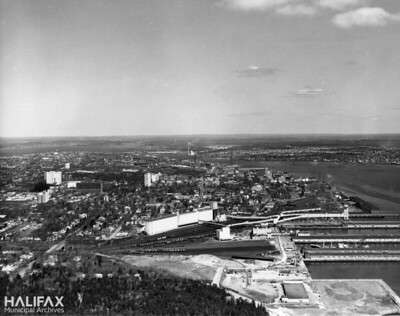
South End Halifax and the Ocean Terminal Rail yards, aerial photograph from Halifax Municipal Archives uploaded May 2024

Head of Northwest Arm showing railway cut and ferry landings from Halifax Municipal Archives uploaded May 2024


Conversations
Here’s a selection of the conversations happening on these photos & illustrations:
Hunters displaying their hunting trophies at Halifax, 1907

- Vesna Verencevic said:
East side of Pleasant St. (now Barrington St.), south of Morris St.
-
Ryan Tucker said:
Looks like it could be the east side of Barrington Street (just south of Morris Street), around 1277 to 1253 Barrington. 1253 & 1259 are still pretty distinct buildings, and 1273-77 Barrington Street (Retrieval Code 102-39-1-512) looks like it could be building on the left.
-
Halifax Municipal Archives said:
Thanks for your identification, Ryan Tucker! The buildings in the photograph have definitely changed quite a bit over the years so it's difficult to be 100% sure, but it does look like you're correct about the location based on the appearance of the surrounding buildings. I've updated the description in the database with the new information - thanks again!
Constructing/repairing underground cisterns at Citadel Hill

-
Halifax Municipal Archives said:
Thanks to Aaron Emm on Facebook post, who recognized these walls from the Citadel. Another photo that was labelled shows the same firefighter in a nearby image: gencat.eloquent-systems.com/halifax-municipal-archives/pe...