crane

568 photos and 16 illustrations tagged crane, from 28 members of Flickr Commons.

When were these photos & illustrations taken?

59
1885
2021


Where were these photos & illustrations tagged?

13% of these photos & illustrations are geotagged.

Tags that often appear on the same photos & illustrations:

Members using this tag

Photos & Illustrations

Show photos & illustrations photos (568) illustrations (16)

A selection of photos & illustrations tagged crane:

Loading photos & illustrations…

See more on flickr.com →

Recent uploads

The last upload was 19 August.

Conversations

Here’s a selection of the conversations happening on these photos & illustrations:

Murray Crane, portrait (LOC)

  • swanq said:
    Winthrop Murray Crane
    en.wikipedia.org/wiki/Winthrop_M._Crane
    "Winthrop Murray Crane (commonly referred to as W. Murray Crane or simply Murray Crane; April 23, 1853 – October 2, 1920) was an American businessman and Republican Party politician who served as the 40th governor of Massachusetts from 1900 to 1903 and represented that state in the United States Senate from 1904 to 1913.

    In 1879, he secured his family company, paper manufacturer Crane & Co., an exclusive government contract to supply the paper for United States currency, a monopoly the company holds to this day. During the 1890s he became increasingly active in state Republican politics, and became a dominant figure in the local, state, and national party. He was successively elected the 37th lieutenant governor of Massachusetts (in 1896) and 40th governor (in 1899). In 1904, he was appointed to the United States Senate and served until 1913.

    Crane advised Presidents Theodore Roosevelt and William Howard Taft. His success as Governor in defusing a Teamsters strike prompted Roosevelt to bring him in as a negotiator to resolve the Coal Strike of 1902. He refused repeated offers for cabinet-level positions and was known to dislike campaigning and giving speeches. Near the end of his career, he served as a political mentor to future President Calvin Coolidge, who was elected vice president one month after Crane's death."

Many hands and social distancing

  • 30 older comments, and then…
  • O Mac said:
    This was taken at Passage West.. The ship is the TSS Arvonia previously TSS Cambria having been renamed in 1919 en.m.wikipedia.org/wiki/TSS_Cambria_(1897)
  • O Mac said:
    We came on this armoured car before. Seen at Passage around the 7th August 1922. flic.kr/p/b8SQmD
  • Foxglove said:
    it appears that there may be more "driving on planks" rather than lifting !
  • Fred Dean Snr. said:
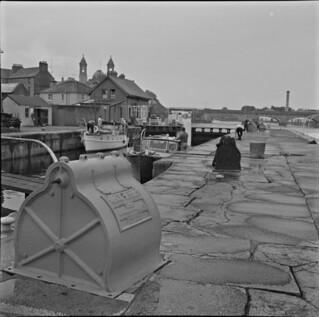
    The crane is a Taylor & Hubbard vertical boiler steam crane. Running on the rails.
  • Fred Dean Snr. said:
    Óglaigh na hÉireann badge on the turret. en.wikipedia.org/wiki/Irish_Defence_Forces_cap_badge

Hopper of coal on a crane being transferred to a ship at Gladstone wharves, 1948

  • Vesna Verencevic said:
    The Port of Gladstone (PoG) is one of Australia’s finest natural deepwater harbours and Queensland’s largest multi-commodity port. The port has eight main wharf centres, comprising 20 wharves in total: RG Tanna Coal Terminal — four wharves owned and operated by GPC Barney Point Terminal — one wharf owned and operated by GPC Auckland Point Terminal — four wharves owned by GPC and operated by others Fisherman’s Landing — four wharves operated by multiple companies South Trees — two wharves operated by Queensland Alumina Limited (QAL) Boyne Wharf — one wharf operated by Boyne Smelters Limited (BSL) Curtis Island — three wharves operated by LNG companies; Australia Pacific LNG (APLNG), Santos GLNG and Queensland Curtis LNG (QCLNG) Wiggins Island Coal Terminal — one wharf operated by Wiggins Island Coal Export Terminal (WICET). Trade The port handles over 30 different products, led by coal, LNG and aluminium, in addition to cement, petroleum and timber. The port handles 42 coal types across 84 stockpile zones. The majority of coal handled at the port is coking coal, which is exported to Japan, South Korea, Taiwan, India, Italy and France for high-quality steel manufacturing. Approximately 30 per cent of the coal exported is thermal, which is used to fuel the boilers of power stations in Japan, Hong Kong, Taiwan, South Korea and Israel. Source: www.gpcl.com.au/ports-and-trade/port-of-gladstone/
  • Vesna Verencevic said:
    The Port of Gladstone’s formal history began in 1914 as the Gladstone Harbour Board. * Auckland Point was where shipping in Gladstone first began. Live horse exports were the main cargo first handled at the then-wooden Auckland Point Jetty in the mid-1930s. The jetty, complete with a cargo shed and supported on cast iron piles, was connected to the shore by a timber neck linking with an embankment 55 meters long formed by excavated material from Auckland Hill. * The approval for the construction of RGTCT (then known as Clinton Coal Facility) at a cost of $45 million was given in 1976-77 when BHP Co Ltd advised it had secured long term contracts for the sale of coking coal to Japanese steel mills. Construction began almost immediately with Stage One reaching completion in 1997-80. The first vessel to berth at the facility was the MV Iron Capricorn which sailed on 24 April 1980 with 26,196 tonnes (t) of Gregory coal on board. RGTCT was officially opened by BHP Chairman Sir James McNeill, in the presence of the then Queensland Premier Sir Joh Bjelke-Petersen, on 7 May 1980. * Interest in utilizing port land at Barney Point was first expressed by Thiess Peabody Mitsui Coal Pty Ltd in the early 1960s for the purpose of exporting Moura coal. Thiess Peabody Mitsui was prepared to construct a private rail line from Moura to Gladstone and consequently, work began on constructing a wharf around the mid-1960s. * In the late 1970s, Queensland Cement Ltd expressed an interest in establishing a clinker plant at Fisherman’s Landing. Construction of the single-berth wharf cost approximately $3.7 million and work was completed during 1980-81. * South Trees In 1962-63, a consortium - Queensland Alumina Limited (QAL) - announced plans to construct the largest alumina plant in the world at Gladstone. * The construction of Boyne Wharf followed the Comalco Ltd decision in 1975-76 to establish a two-potline aluminum smelter at Boyne Island. Source: web.archive.org/web/20111020165825/http://www.gpcl.com.au...