stationers
8 photos and 1 illustration tagged stationers, from 2 members of Flickr Commons.
When were these photos & illustrations taken?
Where were these photos & illustrations tagged?
77% of these photos & illustrations are geotagged.
Related tags
Tags that often appear on the same photos & illustrations:
- ireland
- nationallibraryofireland
- lawrencephotographcollection
- awnings
- glassnegative
- dublin
- leinster
- robertfrench
- williamlawrence
- locationidentified
- shops
- graftonstreet
- cars
- automobiles
- bicycles
- cyclists
- sibleys
- sibleyco
- booksellers
- 20thcentury
- lawrencephotographicstudio
- cotipperary
- munster
- oconnellstreet
Members using this tag
Photos & Illustrations
Show photos & illustrations photos (8) illustrations (1)
Photos & Illustrations tagged stationers:
Loading photos & illustrations…
Recent uploads
The last upload was July 2020.

Big day in Clonmel from National Library of Ireland on The Commons uploaded July 2020

Castle Street, Nenagh, Co. Tipperary from National Library of Ireland on The Commons uploaded September 2016

Fusiliers' Arch from National Library of Ireland on The Commons uploaded January 2014

Grafton Street in all its glory from National Library of Ireland on The Commons uploaded July 2013

D.I.Y. High Cross from National Library of Ireland on The Commons uploaded April 2013

Blackall and McDonagh from National Library of Ireland on The Commons uploaded April 2013

Junction, Rathmines from National Library of Ireland on The Commons uploaded October 2012

Soldiers on Parade... from National Library of Ireland on The Commons uploaded October 2012

Conversations
Here’s a selection of the conversations happening on these photos & illustrations:
Fusiliers' Arch
- 31 older comments, and then…
- derangedlemur said:
- derangedlemur said:
- National Library of Ireland on The Commons said:
- Niall McAuley said:
- Niall McAuley said:
Castle Street, Nenagh, Co. Tipperary
- 20 older comments, and then…
-
Niall McAuley said:
51 and 52 have been replaced by an ugly bank. 50 with the
bayoriel window is still looking good: Streetview, 25" map at GeoHive -
Niall McAuley said:
Oriel window building dates from 1870 per the NIAH
-
Niall McAuley said:
In the window I see David Brett's Nursery Painting Book. I see some books illustrated by a David Brett around 1906-1911, but I can't find that particular book yet.
-
Niall McAuley said:
Imperial Rover sign: Per wikipedia: Rover was established in 1878 by John Kemp Starley in Coventry to produce bicycles. The company developed and produced the Rover Imperial motorcycle in November 1902.
-
Niall McAuley said:
I'm guessing the gent in the shop doorway is Frederick Wm Day He was in Nenagh in 1901, too, but living in Barrack Street.
D.I.Y. High Cross
- 6 older comments, and then…
-
blackpoolbeach said:
Leonard Bentley and DannyM8 give this location as Athenry, Galway on Google Street View
-
DannyM8 said:
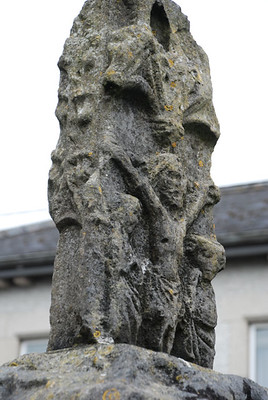
homepage.tinet.ie/~foregan/adc/cross.html#cross Unique In Ireland! By Prof. Etienne Rynne In Athenry's Market Square is an unusual monument consisting of a steeply stepped pyramidal base on which is set a carved socket-stone with an upright, rectangular-sectioned sculpted stone on its top. Known as the Market Cross, this monument does not really present the appearance of being a cross, despite the carving of a crucifixion on one face of the upright stone. It is, in fact, the last remnants of a fine Late Medieval Gothic cross of Tabernacle or Lantern type. Such crosses, dating from the 15th century perhaps mainly from the second half of that century, arc well-known in Britain (mainly, in England, Cornwall and south Wales) in Northern France, in Germany, and elsewhere in Gothic Europe - but for Ireland the Athenry monument is a unique example such crosses get their name because instead of a transom as a cross-head they have a rectangular swelling, generally with a pointed roof-like top, which has an appearance vaguely resembling a lantern or tabernacle. Almost invariably such crosses have a long, tapering generally plain but chamfered shaft set into a sculpted socket which is on top of a large and often quite high stepped pyramidal base. These crosses are not crucifixes though most bear a crucifixion scene carved on the main face of the tabernacle-like part. The Athenry market cross fits into this general pattern, only the long shaft and roof-like portion now missing. The pyramidal base consists of four steep-steps, well built of large stones (also a low, step-like surround of concrete at ground-level). Excluding the concrete surround, the base measures 2.46m. by 2.38m. at its bottom, and the steps, from the bottom upwards, measure 48 cm., 49 cm., 44 cm. and 52 cm. in height, giving an overall height of almost ( just over 6 ft.). On the top of the stepped base is set a virtually square stone, 40 cm. by 41 cm. and 26m. high, clearly the original socket-stone for the now-missing shaft. Its lower 14 cm. is vertical and plain, while its upper portion is sloping and carved with, among other things, a stag, a winged quadruped, fighting and other dog-like animals, an angel holding a long scroll diagonally across its body, and two opposed jani (mythological quadrupeds with single horns which they could swivel around) with interlocked necks; these latter resemble those on the doorway into Clontuskert Abbey, near Ballinasloe, dated to 1471, which thus helps date the Athenry cross. The upright stone now set into the socket-stone is the tabernacle / lantern-like part of the cross, though now missing its top and bottom. Enough of it remains to show that it was a finely-carved piece, with two wide faces (the front and the back) and two narrower ones on the side. All faces are recessed the recesses surmounted by crocketted and pinnacled arched two over the front recess and one over each of the others. The front recess contains a carved cruciform scene, with Our Lady and St. John standing on either side of the cross. The back recess contains a carving of the Madonna and Child, while the two side-recesses are flat and plain - such undecorated recesses are quite common on crosses of this type and were almost certainly intended for a painting of a saint or religious scene or symbol; indeed, the whole cross-head and its socket-stone may well have been coloured originally The proportions of the sculpted heads to the tapering shafts of a sample of such crosses varies greatly, but averages out at about 1:3. As the incomplete head of the Athenry cross is 69 cm. high, and was originally about l0 cm. more, it can be estimated that the shaft would probably have been something in the region of 2.25 m. high. Judging from the measurements of the base of the cross-head (30 cm. by 20 cm.) and those of the top of the socket-stone, the shaft would have been about 25 cm. by 15 cm. at its top and 40 cm. by 41 cm. at its bottom. With such a shaft the cross would look something like the accompanying drawing. To restore the Athenry market cross is a definite possibility and would be a relatively easy matter. The result would be a unique, for Ireland, and an outstandingly impressive monument. While the overall height would be in the region of 5m. this would not be excessive for monuments of its type, many of which are considerably higher (as also are many of Ireland's high Crosses).
-
DannyM8 said:
From eastcoastbychoice's Photostream
-
Mike said:
Surely those are not corsets I see hanging in the shop window. Once again a great photo.
-
Niall McAuley said:
Dating info! Per the NIAH, this must be before 1870, when the Ulster Bank was built on the site of this corset shop.