curtissmodelf
50 photos and 1 illustration tagged curtissmodelf, from 3 members of Flickr Commons.
When were these photos & illustrations taken?
Where were these photos & illustrations tagged?
None of these photos & illustrations are geotagged.
Related tags
Tags that often appear on the same photos & illustrations:
- aircraft
- curtiss
- airplane
- flyingboat
- biplane
- seaplane
- curtissf
- aviation
- modelf
- earlyaviation
- flight
- flying
- aerial
- airborne
- photography
- smu
- southernmethodistuniversity
- library
- archives
- plane
- navalaviation
- unitedstatesnavy
- usnavy
- usn
Members using this tag
Photos & Illustrations
Show photos & illustrations photos (50) illustrations (1)
A selection of photos & illustrations tagged curtissmodelf:
Loading photos & illustrations…
Recent uploads
The last upload was April 2018.

curtiss model f flying boat over water reproduction on canvas artist charles h. hubbell from SDASM Archives uploaded April 2018

Capt Cowan. from SMU Libraries Digital Collections uploaded August 2017

Curtiss Flying boat. from SMU Libraries Digital Collections uploaded August 2017

[Pilots and Students with Curtiss F-Boat] from SMU Libraries Digital Collections uploaded August 2017

[Curtiss F-Boat in Flight Over Water] from SMU Libraries Digital Collections uploaded August 2017

Curtiss Flying Boat from SMU Libraries Digital Collections uploaded August 2017

[Curtiss F-Boat over North Island] from SMU Libraries Digital Collections uploaded August 2017

[Curtiss F-Boat on Water] from SMU Libraries Digital Collections uploaded August 2017

[Army Air Service Curtiss F in Water] from SMU Libraries Digital Collections uploaded August 2017

[Curtiss F-Boat in Flight Over San Diego Bay] from SMU Libraries Digital Collections uploaded August 2017

[Curtiss Model F in Flight Over Water] from SMU Libraries Digital Collections uploaded August 2017

[Curtiss Model F on San Diego Bay] from SMU Libraries Digital Collections uploaded August 2017

[Curtiss Model F Near Shoreline] from SMU Libraries Digital Collections uploaded August 2017

[Glenn Curtiss and Passenger in Curtiss Model F] from SMU Libraries Digital Collections uploaded August 2017

[Curtiss Model F at Rest in San Diego Bay] from SMU Libraries Digital Collections uploaded August 2017
Conversations
Here’s a selection of the conversations happening on these photos & illustrations:
David McCulloch (LOC)

- pennylrichardsca (now at ipernity) said:
- B-59 said:
- Arden said:
- TVL1970 said:
Curtiss F

from SDASM Archives
-
TVL1970 said:
This actually appears to be Keuka Lake, New York.
-
Batman_60 said:


I took the above photos on September 15, 2012 at the Seaplane Homecoming in Hammondsport, NY, of the Curtiss "Model E" replica N1913E, built and flown by the Glenn Curtiss Museum.
As with all early Curtiss models, there is confusion (at least by this humble enthusiast) as to which flying boat this replica is designed to emulate. The Putnam volume by Peter M. Bowers mentions an Army No. 15, one of a number of experimental flying boats flown c. 1912 and referred to as the "E-Boat", which is what the Curtiss Museum calls their flying replica, but there is no mention of a "Model E" flying boat as such.
There was the Curtiss "A-2", the Navy's second airplane, which was delivered as a landplane in 1911, converted to a float seaplane in June 1912, and in October 1912 modified with a boat-like enclosure over the pilots and float, effectively becoming what some sources refer to as the "Navy's first flying boat". This machine later got retractable wheels and was called the "OWL" (Over Water and Land). In October 1913 the Navy changed its designation to "E-1", followed by a further change to "AX-1". But this aircraft had an open structure supporting the tail, and looked nothing like the replica.
The San Diego Air and Space Museum's Flickr site has two images of a similar aircraft which it refers to as "Model E : #2 Flying Boat - 1912, 1st successful flight – Flying Fish".

While sources agree that the Curtiss Flying Boat #2 "Flying Fish", the first to actually leave the water and fly, was the world's first successful flying boat, it is clearly different from the replica, at least in the shape of the tail.
The replica's registration is N1913E, indicating a 1913 model, by which time Curtiss was building the Model F, of which many variants were constructed for several years. Here are two Model Fs in 1916 at a Curtiss flight school in Newport News. The similarity to the Museum's flying replica is noteworthy.
So my guess is that the N1913E, built in 1998, is a composite design containing features of the "Army No. 14 E-boat", the "Flying Boat #2 - Flying Fish", and the 1913 Model F.
Bowers also makes reference to the "erroneous" use of the term "E-Boat" when referring to the 1913 Model F. Without further information I would never go as far as accusing the Museum or the builders of this amazing machine of an error, but the above gives the reader some idea as to the complexity and ambiguity of identifying century old products from such a prolific genius as Glenn Curtiss.
Information appreciated - if anyone has a more accurate grasp of the situation, please comment!
The replica also features standard three axis controls as opposed to the sliding seat aileron control/steering wheel rudder used in the early Curtiss boats, as no pilot alive would be able to re-train his or her muscle memory to safely fly the earlier fomat. It was launched into the lake on a beaching trolley on a railroad-like track. The pilot first flew the display flight's course in a Cessna 180 floatplane to determine if it was safe to fly. When the crowd finally got to see the old Curtiss fly it performed very far away from the park where the spectators were, and where all the other seaplanes present were operating all day. He flew two takeoffs, distant circuits, and landings, landing downwind both times. My photos are of the second pass. It was rumored that this was the last time it was to fly. -
Stig Jarlevik said:
Batman is very much correct when he speaks of "the Curtiss confusion" and the reason is Curtiss or perhaps rather the factory itself, which used the same type letters over and over again. For intance when the US Navy in 1911 bought two model E, they were 1911 model E and were not flying boats but float planes. In 1912 Curtiss again used the letter as 1912 model E which was a flying boat and the prototype is what we see here. The 1912 model E was modified with a new tail (adapted on the model F) and extended wing tips and creating what can be called the 1912/13 model E. The US Navy C-1 should belong here I believe. Then we have the 1913 model E which in the past have been confused with the 1913 model F (the differences are minute) and I think that the replica N1913E in fact is a 1913 model E as claimed. No proof on my part, but then again I am not much for building anything.... The problem is also that in details, one can have two 1913 model E photos and not even those two look exactly the same. Curtiss and his mechanics constantly tinkered with modifications back and forth and in the end I wonder if even they knew exactly what it was..... :-) Stig
Gould, Davison, Gates (LOC)

-
Art Siegel said:
Members of the First Yale Unit, Port Washington, L.I. See notes under
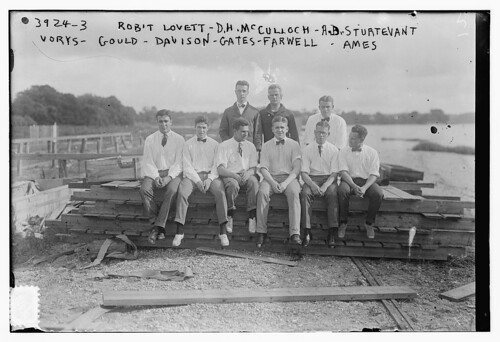
Rear Admiral Erl Clinton Barker Gould (1895-1968) www.millionairesunit.org/index.php?option=com_content&...
Frederick Trubee Davison (February 7, 1896 - November 14, 1974) was an American World War I aviator, Assistant US Secretary of War, Director of Personnel for the Central Intelligence Agency, and President of the American Museum of Natural History. en.wikipedia.org/wiki/Frederick_Trubee_Davison
Artemus Lamb Gates (November 3, 1895 – June 14, 1976) was an American businessman, naval aviator, and Assistant Secretary of the Navy for Air in charge of naval aviation efforts in World War II.
en.wikipedia.org/wiki/Artemus_Gates -
Barbara (LOC P&P) said:
Thanks for providing all the information and links to resources. We'll add information when we next update the description.