leofrank
7 photos tagged leofrank, from 1 member of Flickr Commons.
When were these photos taken?
Where were these photos tagged?
None of these photos are geotagged.
Related tags
Tags that often appear on the same photos:
- libraryofcongress
- xmlns:dc=httppurlorgdcelements11
- georgia
- man
- frank
- woman
- portrait
- lynching
- firstlady
- governor
- atlanta
- crime
- murder
- jewish
- strawboaters
- maryphagan
- dc:identifier=httphdllocgovlocpnpggbain13934
- grant
- seated
- dc:identifier=httphdllocgovlocpnpggbain14841
- dc:identifier=httphdllocgovlocpnpggbain19362
- standing
- couple
- fulllength
Members using this tag
Photos
Photos tagged leofrank:
Loading photos…
Recent uploads
The last upload was February 2013.

Frank Home, Br'klyn [i.e., Brooklyn] (LOC) from The Library of Congress uploaded February 2013

Prison, Milledgeville -- Frank's cot (LOC) from The Library of Congress uploaded December 2012

Eugene N. Foss (LOC) from The Library of Congress uploaded November 2012

Ex-Gov. John Slaton and wife (LOC) from The Library of Congress uploaded November 2012

Mrs. John Slaton (LOC) from The Library of Congress uploaded October 2012

Mrs. John M. Slaton (LOC) from The Library of Congress uploaded April 2010

Leo Frank (LOC) from The Library of Congress uploaded October 2009
Conversations
Here’s a selection of the conversations happening on these photos:
Prison, Milledgeville -- Frank's cot (LOC)
- B-59 said:
- Art Siegel said:
- Leo Frank said:
Eugene N. Foss (LOC)
- 1 older comment, and then…
-
bior said:
From Wikipedia, Eugene Foss "was an American Representative and the 45th Governor of Massachusetts, as well as brother of George Edmund Foss."
-
swanq said:
bioguide.congress.gov/scripts/biodisplay.pl?index=F000293
"FOSS, Eugene Noble, (brother of George Edmund Foss), a Representative from Massachusetts; born in West Berkshire, near St. Albans, Franklin County, Vt., on September 24, 1858; attended the public schools, Franklin County Academy at St. Albans, Vt., and the University of Vermont; settled in Boston, Mass., in 1882; engaged in the manufacture of iron and steel products; elected as a Democrat to the Sixty-first Congress to fill the vacancy caused by the death of William C. Lovering and served from March 22, 1910, until his resignation, effective January 4, 1911, having been elected Governor of Massachusetts, in which capacity he served from 1911 to 1913; unsuccessful candidate for reelection as Governor in 1912; resumed his former manufacturing pursuits, and managed his large real estate holdings in Boston, Mass.; died in Jamaica Plain (Boston), Mass., September 13, 1939; interment in Forest Hill Cemetery." -
Art Siegel said:
Though his political career was over by 1915, Foss was in the news that year in connection with 3 events. First, he led a delegation to Georgia to plead for commutation of the death sentence given Leo M. Frank. Then, he was involved in the threatened labor troubles among machinists doing war work in July and August of that year, as he controlled 2 machine shops in Massachusetts.
select.nytimes.com/gst/abstract.html?res=F20B11FF385B1773...
Later in the year, he ran unsuccessfully for the his party's nomination as its candidate for governor of Massachusetts.
Leo Frank: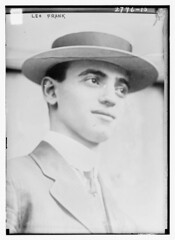
Ex-Gov. John Slaton and wife (LOC)
-
pennylrichardsca (now at ipernity) said:
His wikipedia entry: en.wikipedia.org/wiki/John_M._Slaton She was Sarah "Sally" Frances Grant; here she is elsewhere on Flickr:
-
Ryan (LOC P&P) said:
Thanks so much pennylrichardsca for providing his wife's name. We'll add this information to the record the next time we update.
-
Art Siegel said:
They had to flee Georgia after the Governor commuted the sentence of convicted murderer Leo Frank, in one of the era's most sensational cases, and a cause celebre for many. Frank was lynched by an angry mob after Gov. Slaton commuted his sentence.