precision
40 photos tagged precision, from 3 members of Flickr Commons.
When were these photos taken?
Where were these photos tagged?
17% of these photos are geotagged.
Related tags
Tags that often appear on the same photos:
- industry
- blackandwhitephotograph
- digitalimage
- unitedkingdom
- unusual
- northeastofengland
- industrialheritage
- archives
- grain
- blur
- mark
- interesting
- documentation
- production
- fascinating
- construction
- components
- wall
- view
- tyneweararchivesmuseums
- equipment
- documentaryphotograph
- glimpse
- development
Members using this tag
Photos
Photos tagged precision:
Loading photos…
Recent uploads
The last upload was April 2024.

Female munitions worker Rocklea Brisbane from State Library of Queensland uploaded April 2024

Women working at a munitions factory in Queensland during World War II from State Library of Queensland uploaded April 2024

Women's Army workers assembling gun sights at a workshop, Queensland, 1945 from State Library of Queensland uploaded April 2024

Illustrated page from The Queenslander annual, October 1, 1930, p. 11 - boroni from State Library of Queensland uploaded October 2023

The two halves of the Tyne Bridge meet from North East Museums uploaded June 2017

Manoeuvring prefabricated sections at Readhead's shipyard from North East Museums uploaded January 2016

Working on a propeller at Readhead's shipyard from North East Museums uploaded January 2016

Drilling cylinder blade stops (1914 – 18) from North East Museums uploaded May 2015

Turning flanges (1914 – 18) from North East Museums uploaded May 2015

Filling out brush boxes (1914 – 18) from North East Museums uploaded May 2015

Radiusing ends of slots in mirror ring (1914 – 18) from North East Museums uploaded May 2015

Insulating stator end windings (1914 – 18) from North East Museums uploaded May 2015

Milling rotor wedges (1914 – 18) from North East Museums uploaded May 2015

Model maker at work at the North Sands shipyard from North East Museums uploaded January 2015

Conversations
Here’s a selection of the conversations happening on these photos:
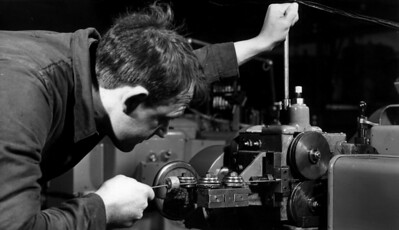
A shipwright at work at Doxfords, Sunderland

from North East Museums
-
optimal chicken said:
There are some incredible photos of Doxford Engines in its machine shops. It's hard to believe that all has gone now though and all those skills lost - a shame..
Woman from the Australian Women's Auxiliary Service testing gas masks at an ordnance depot, Australia, 1945
-
Vesna Verencevic said:
The Aust Army Ordnance Corps (AAOC) in the World War 2 was one of the corps which supplied the Army with the materials it needed to live, move and fight. The Aust Army Service Corps (AASC) supplied the consumable items, such as food and fuel, while the Royal Aust Engineers (RAE) and Corps of Signals maintained supply branches to distribute the specialist engineer stores and signals equipment. AAOC supplied the ammunition as well as the non-consumable items for which the receiver was accountable. These include the weapons, munitions and vehicles as well as the tents, knives and forks, clothing and the spare parts to maintain the vehicles and equipment. AAOC did not generally undertake the distribution of their stores to units as the transport function was undertaken by AASC. Source: search.informit.org/doi/abs/10.3316/informit.454344815385...