14thairforce
59 photos tagged 14thairforce, from 1 member of Flickr Commons.
When were these photos taken?
Where were these photos tagged?
None of these photos are geotagged.
Related tags
Tags that often appear on the same photos:
- worldwartwosquadrongroup
- 19411945
- 16thsquadron
- bombardmentgroup
- p40s
- aviation
- aircraft
- airplane
- militaryaviation
- prattwhitney
- r1830
- prattwhitneytwinwasp
- prattwhitneyr1830twinwasp
- bomber
- consolidatedaircraft
- consolidatedb24liberator
- consolidatedb24
- b24liberator
- consolidatedliberator
- liberator
- b24
- prattwhitneyr1830
- twinwasp
- 308thbombgroup
Members using this tag
Photos
A selection of photos tagged 14thairforce:
Loading photos…
Recent uploads
The last upload was October 2012.

308th Bomb Group, 14th Air Force, B-24 Liberator from SDASM Archives uploaded October 2012

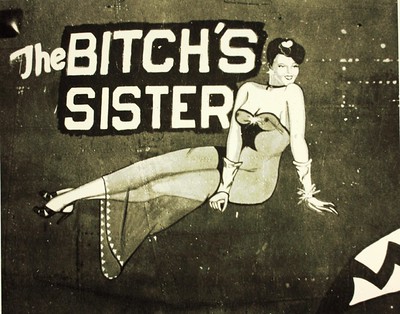
42-73319 BITCH'S SISTER 14AF 308BG 375BS B-24 Liberator from SDASM Archives uploaded October 2012

308th Bomb Group, 14th Air Force, B-24 Liberator from SDASM Archives uploaded October 2012

308th Bomb Group, 14th Air Force, B-24 Liberator from SDASM Archives uploaded October 2012

308th Bomb Group, 14th Air Force, B-24 Liberator from SDASM Archives uploaded October 2012

308th Bomb Group, 14th Air Force, B-24 Liberator from SDASM Archives uploaded October 2012

308th Bomb Group, 14th Air Force, B-24 Liberator from SDASM Archives uploaded October 2012
308th Bomb Group, 14th Air Force, B-24 Liberator from SDASM Archives uploaded October 2012

308th Bomb Group, 14th Air Force, B-24 Liberator from SDASM Archives uploaded October 2012

308th Bomb Group, 14th Air Force, B-24 Liberator from SDASM Archives uploaded October 2012

308th Bomb Group, 14th Air Force, B-24 Liberator from SDASM Archives uploaded October 2012

308th Bomb Group, 14th Air Force, B-24 Liberator from SDASM Archives uploaded October 2012

308th Bomb Group, 14th Air Force, B-24 Liberator from SDASM Archives uploaded October 2012

308th Bomb Group, 14th Air Force, B-24 Liberator from SDASM Archives uploaded October 2012

308th Bomb Group, 14th Air Force, B-24 Liberator from SDASM Archives uploaded October 2012
Conversations
Here’s a selection of the conversations happening on these photos:

Bombardment Group; 14th Air Force; 16th Squadron; P-40s

from SDASM Archives
-
Adamant Walk said:
Was this man an officer of the Kuomintang's military police force during his country's war against Japan? If yes, that means back in those years of war, even the Republic of China's military policemen had also been deployed to fight against the Japanese invaders, who had already conquered much of China by then. Anyway, was the city in this photo, actually Chungking, which was the Republic of China's temporary capital from 1938 until 1945?
308th Bomb Group, 14th Air Force, B-24 Liberator
from SDASM Archives
-
Vitamin-P said:
B-24J 44-40780 RED HOT RIDING HOOD flew with the 14AF 308BG 374BS. It lfew its first combat mission on 29 Jul 1944, and its last on 9 Oct 1944. On 9-Oct-1944, Red Hot Riding Hood took off for a mission to lay mines on the Yangtze River, 200 miles south of Wuchang-Hankow. They failed to return and were declared MIA. Mine laying procedures would have the bomber descend to an altitude of 400 feet above the river. A Chinese civilian in the village of Hsia-k’eng witnessed the airplane explode in mid-air. He found the remains of eight crewmen. The pilot and copilot probably fell into the river and were not recovered. The Chinese collected the remains and buried them in small bamboo coffins. Four years later, someone from the village notified the U.S. consulate in Hankow of the eight graves. On 8-Jan-1948, Mary Schlentz, the navigator’s widow, received a telegram from the adjutant general in Washington, D.C., that her husband’s remains had been located and were being transferred to Schofield Barracks, Hawaii. Forensic tests were able to identify S/Sgt. Walter E. Wilson, and he was buried in the National Memorial Cemetery of the Pacific in Hawaii. The seven others were buried as a group with a single granite marker at Jefferson Barracks National Cemetery, St. Louis, Missouri, on 29-Sep-1949. Crew lost on final mission: 1st Lt. James W. Dunlap, pilot 2nd Lt. Theodore N. Dickson, copilot 2nd Lt. George A. Lescher, bombardier 2nd Lt. Wayne S. Schlentz, navigator T/Sgt. James W. Brown, radio operator T/Sgt. William S. Clarke, flight engineer S/Sgt. Harold R. Dawson, gunner S/Sgt. Ira J. Ingle, gunner T/Sgt. Thadeus Nocek, gunner S/Sgt. Walter E. Wilson, radar operator
-
Vitamin-P said:
Copilot “Ted” Dickson’s remains were recovered farther down the river and buried not far from the “Wuhan” cities. His grave was brought to the attention of the Graves Registration Service before the other eight were found. The pilot, Jim Dunlap, was never found. Dickson’s remains were brought to Schofield Barracks Mausoleum, and after final identification, the remains were brought back to San Francisco in August 1949. Mrs. Pat Meredith of Tacoma Washington, a younger sister, was given the option of having Ted buried at Arlington National Cemetery or in Tacoma. She asked that his coffin be brought to Tacoma. An officer with the rank of Captain accompanied the casket and was present at the funeral service and burial in a local cemetery on August 19, 1949.