rad
6 photos and 1 illustration tagged rad, from 7 members of Flickr Commons.
When were these photos & illustrations taken?
Where were these photos & illustrations tagged?
14% of these photos & illustrations are geotagged.
Related tags
Tags that often appear on the same photos & illustrations:
- bldigital
- date1847
- pubplacelondon
- publicdomain
- sysnum003895033
- westtheresacornwallisjmrs
- small
- vol0
- page232
- mechanicalcurator
- imagesfrombook003895033
- imagesfromvolume0038950330
- sherlocknet:tag=principe
- sherlocknet:tag=town
- sherlocknet:tag=consider
- sherlocknet:tag=public
- sherlocknet:tag=tract
- sherlocknet:tag=river
- sherlocknet:tag=state
- sherlocknet:tag=portion
- sherlocknet:tag=battle
- sherlocknet:tag=city
- sherlocknet:tag=fertile
- sherlocknet:tag=island
Members using this tag
- California Historical Society
- The Library of Congress
- SDASM Archives
- National Library of Ireland on The Commons
- State Library of Queensland
- Nationaal Archief
- British Library
Photos & Illustrations
Show photos & illustrations photos (6) illustrations (1)
Photos & Illustrations tagged rad:
Loading photos & illustrations…
Recent uploads
The last upload was January 2023.

sdasm image from SDASM Archives uploaded March 2018

[Young boy on tricycle] from California Historical Society uploaded May 2014

Robert French from National Library of Ireland on The Commons uploaded January 2014

British Library digitised image from page 232 of "A Summer Visit to Ireland in 1846" from British Library uploaded November 2013

Hellend scheprad / Angled paddle wheel from Nationaal Archief uploaded December 2009

Weavers at work (LOC) from The Library of Congress uploaded January 2008
Conversations
Here’s a selection of the conversations happening on these photos & illustrations:
Robert French
- 52 older comments, and then…
- Niall McAuley said:
- Niall McAuley said:
- National Library of Ireland on The Commons said:
- beachcomber australia said:
- Niall McAuley said:
Weavers at work (LOC)
- 20 older comments, and then…
-
[ aboring ] said:
this is all SO very cool!!
-
neotoma73 said:
It looks like they're weaving rugs and coverlets on jack looms.
-
Patrick said:
This is indeed awesome...like peering back through a time machine.
-
Erika Morrison Bunda said:
Beautiful vintage clothing*~*
-
Mark Byron said:
This photo was taken by my Great Grandfather Percy Byron. The Byron Company NY has a large collection at mcny.org over 22,000 prints.
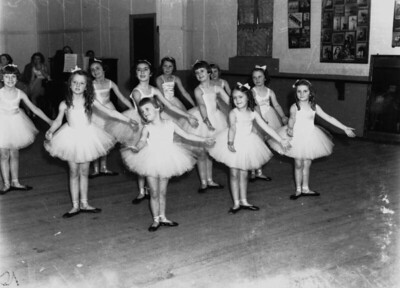
Young girls competing at the Royal Academy of Dancing (London) exams held in Brisbane and Toowoomba, 1938
-
Vesna Verencevic said:
The Royal Academy of Dance method, also referred to as the English style of ballet, was established in 1920 by Genee, Karsavina, Bedells, E Espinosa, and Richardson. The goal of this method is to promote academic training in classical ballet throughout Great Britain. This style also spread to the United States, and is widely utilized still today. There are specific grade levels which a student must move through in order to complete training in this method. The key principle behind this method of instruction is that basic ballet technique must be taught at a slow pace, with difficulty progression often much slower than the rest of the methods. The idea behind this is if a student is to put in a large amount of effort into perfecting the basic steps, the technique learned in these steps allow a student to utilize harder ones at a much easier rate. Source: www.wikiwand.com/en/Ballet
Hellend scheprad / Angled paddle wheel
from Nationaal Archief
-
remaha1957 said:
De uitvinding werd getest in droogmakerij Bleiswijk in 1775-1776. Er werd een jaar lang met 4 molens , 2 standaard scheprad en 2 met hellend rad, meer dan 160 proeven gedaan , de uitkomst was licht in het voordeel van hellend scheprad . De proeven werden beschreven door wiskundige B.J.Douwes zie books.google.nl/books In de Bataafs-Franse tijd is er opnieuw belangstelling voor dit ontwerp, zie archief inspecteurs van Waterstaat 2.16.06 inv. nr 690 Nationaal Archief . web2ontdekker 23archiefdingen